Next Project: WuWa Planner?!
It has been several weeks since the Fall quarter started, and I have finally carved out time to build a new portfolio project. I had an itch to build something that challenges me and helps me learn further.
The goal was clear: I wanted to create an app that was not just functional, but genuinely interesting to me. I wanted to ensure I would stick to it from start to finish while gaining a tangible demonstration of my abilities.
The process of choosing a “Wuthering Waves Planner” was not instant. It involved brainstorming, self-assessment, and a healthy dose of what I am currently passionate about outside of coding.
Brainstorming Phase
I initially thought widely and considered a few different paths:
- A task manager: I have been interested in time-blocking tools since working on a design in my UX course. Ultimately, I wanted something more unique than another to-do app.
- An inventory system: After tracking tech inventory over the summer, I considered building an app with a map overview of equipment locations. However, it didn’t spark that immediate “I need to build this” feeling.
- A personal finance tracker: I enjoy using YNAB and thought about building something similar. I worried, however, that I would just end up with a simple CRUD project without enough unique pain points to solve.
This process helped me narrow it down to two strong contenders tied directly to my personal hobbies.
 The final showdown: A practical workout app versus a complex gacha planner.
The Showdown: Calisthenics vs Gacha
On one hand, I had the calisthenics workout app. As someone who has been training for several months, I have a real need for a personalized app to track progressive overload. It was a practical, passion-driven idea.
On the other hand, I had the Wuthering Waves Planner. I have been playing the game recently and saw two clear technical challenges: the complex “shopping list” calculation for ascension materials and the puzzle of simulating the gacha probability system.
Why the Wuthering Waves Planner Won
While the calisthenics app solved a personal problem, the Wuthering Waves planner offered a more unique set of technical challenges.
The planner challenges me to learn complex backend queries on a pre-seeded database and build interactive frontend components with probability logic. After finishing a Statistics course this summer and currently studying Databases, I thought it would be fun to reinforce those two subjects.
Defining the Roadmap
Just picking a project is not enough. To avoid getting overwhelmed, I knew I needed a clear roadmap. I learned that for any portfolio project, I should not try to build everything at once.
I broke the planner down into four distinct phases. Each phase has a clear goal and builds on the previous one.
The Technology Stack
Because I am focused on mastering backend logic, Ruby on Rails was the clear choice.
- Backend: Ruby on Rails (the core of the project).
- Database: PostgreSQL (the production-level standard for Rails).
- Deployment: Kamal for container-based deployment on a DigitalOcean Droplet.
Instead of an easier platform like Render, I am specifically choosing this route. I want to learn how to manage my own deployments from scratch on a VPS.
Phase 0: The Infrastructure
The Goal: Get a “Hello, World!” app live and stable using the production deployment stack.
By setting up the deployment pipeline before writing complex code, I am front-loading one of the biggest technical challenges. I would love to learn how to get a deployable app working from Day 1, rather than saving infrastructure headaches for the end.
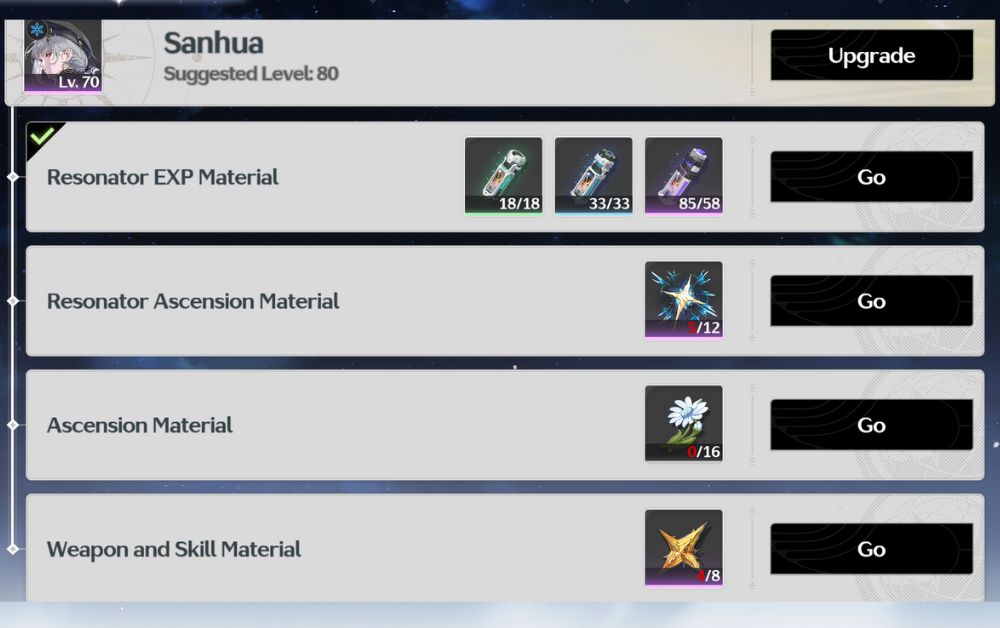 The exact “shopping list” problem that Phase 1 (The Ascension Planner) is designed to solve.
Phase 1: The Ascension Planner
The Goal: Pure backend and database mastery.
This is the foundation for all future features. It will be a public-facing tool, meaning anyone can use it without an account. By intentionally not building user accounts yet, I am avoiding early complexity to ensure I finish the core feature.
- Static Data: I will create a
seeds.rbfile to pre-populate the database with game data like characters and materials. - The Calculator: A simple form to select a character, current level, and goal level.
- The Shopping List: When submitted, the page will show the total summed quantity of every material needed.
Phase 2: The Simulator
The Goal: Frontend and algorithmic logic mastery.
After the planner is deployed, I will add the Gacha Simulator. This is where I will dive into JavaScript using StimulusJS. The challenge here is writing the probability logic to accurately simulate the game’s system, including soft pity (increasing chances after 65 pulls) and the “50/50” guarantee system.
 The challenge for Phase 2: accurately simulating the complex probability and pity systems behind these pull buttons.
Phase 3: The Polish
The Goal: Showcase a mature, full-feature application. These are the features that turn a tool into a true application:
- User Accounts: Using the Devise gem to let users save their plans.
- Inventory Tracking: Allowing users to input current materials so the planner can subtract them from the total needed.
- Expanded Data: Adding weapons and character skills to the calculator.
By breaking it down this way, the project feels ambitious but achievable. I am starting with the infrastructure in Phase 0 and will document my progress as I go.
Time to get that server provisioned.